
Al-Qadsiah 3-3 Al-Ettifaq: Six Scorers, One Referee's Correction, and a Data Vacuum
**Câu trả lời cốt lõi**: Trận derby Saudi Pro League giữa Al-Qadsiah và Al-Ettifaq kết thúc 3-3 với sáu cầu thủ ghi bàn khác nhau. Điểm đáng chú ý nhất là việc trọng tài rút nhầm thẻ vàng thứ hai, kịp sửa sai và xin lỗi ngay trên sân. Al-Qadsiah vẫn xếp thứ hai với 16 điểm. **Dữ kiện chính**: - Tỷ số 3-3, sáu người ghi bàn: Quinones, Retegui, Celina, Medran, Al-Qahtani, Larsson. - Trọng tài người Tây Ban Nha rút nhầm thẻ vàng thứ hai, sửa sai và xin lỗi; không có thẻ đỏ. - Năm thẻ vàng được rút ra; cầu thủ hai đội bật cười sau lời xin lỗi. - Al-Qadsiah đứng thứ hai với 16 điểm, kém Al-Ittihad đúng một điểm. - Al-Ettifaq đứng thứ bảy với 11 điểm sau trận hòa. **Nguồn**: Báo cáo trận đấu Saudi Pro League, mùa giải 2025-26 | Cross-checked: VuaBong.vn **Hỏi đáp liên quan**: Q: Al-Qadsiah còn cơ hội vô địch không? A: Còn, họ xếp thứ hai với 16 điểm và chỉ kém đội đầu bảng Al-Ittihad một điểm sau trận hòa này. Q: Vì sao trận đấu thiếu phân tích chiến thuật? A: Nguồn công khai chỉ cung cấp người ghi bàn, số thẻ và tỷ số, thiếu xG và PPDA nên không thể đánh giá quá trình thi đấu. Q: Sự cố trọng tài có dẫn tới án phạt nào không? A: Không, trọng tài đã sửa sai ngay trên sân và xin lỗi, không có án phạt chính thức nào được ghi nhận.
The referee pulled the yellow card from his chest pocket, raised it to eye level, and froze. He had just called out a player's name, just reached into the pocket, just prepared to let a second yellow leave his fingers. Then he realised he was standing in front of the wrong man.
He lowered his hand. He apologised. On the pitch, players from both sides burst out laughing.
That moment lasted less time than a goal kick, yet it became the most shared fragment of the derby between Al-Qadsiah and Al-Ettifaq. A match that finished 3-3 with six different scorers: Quinones, Retegui, Celina, Medran, Al-Qahtani, Larsson. Five yellow cards. One on-field apology. And almost no published process data for a reader to verify anything against.
I sat with this match longer than necessary. Not because it was hard to understand, but because it is easy to understand in a dangerous way.
Al-Qadsiah arrived at this fixture second in the table on 16 points, exactly one behind leaders Al-Ittihad. Al-Ettifaq sat seventh on 11 points. A derby: one side chasing a title, one side comfortable in mid-table. This is the classic architecture of what the media likes to call a season-defining fixture — the strong team cannot afford to drop points, the weaker team has nothing to lose.
The 3-3 draw cost Al-Qadsiah the chance to go top. They remain second, still one point off the summit, still in control of their own fate. But in a race where the gap between first and second is measured in a single win, dropping two points at home is an event with weight. It does not break a season. It narrows the margin for error.
The match took place inside a wider context that I cannot ignore, because the transfer window is open and every football story in this region must now be read through money. The Saudi Pro League has moved from being a free-spending market to a structured recruitment system. The presence of names like Retegui, Quinones and Larsson on a scoresheet is not an accident. It is the output of a chain of decisions: scouting, negotiating release clauses, restructuring the wage bill, and calculating what a derby goal is worth against a place in the top two.
Release-clause structure and wage bills are the real story behind matches like this. Yet the public only receives the scoreline, the scorers and the cards. That imbalance matters, and I will return to it.
Six names, and why that is bigger than a hat-trick
In my own tracking archive, I classify matches by the distribution of goals before I classify them by anything else. A match with six goals and two scorers is a match with a centre. A match with six goals and six scorers is a match without one. Those two things tell entirely different stories about how the ball moved.
Six different scorers in a single match is rarer than a hat-trick. A hat-trick is the signature of an individual overwhelming a defensive structure. Six names is the signature of a defensive structure that can no longer contain anyone. The ball arrived from multiple points, and no point was sealed.
For Al-Qadsiah the scorers were Quinones, Retegui and Medran. For Al-Ettifaq they were Celina, Al-Qahtani and Larsson. Three each. A near-perfect symmetry of distribution. In my coding system, a match with three or more scoring sources per side usually falls into the category I mark as an open structure — where both midfields are constantly stretched and full-backs are forced to choose between covering and holding position.
But I have to state my limits clearly. Scorer distribution is outcome data, not process data. It tells me goals came from many sources; it does not tell me why. For that I would need expected goals, passes allowed per defensive action, heat maps of ball recoveries. This match provided none of it.
The code table does not need to remember; it remembers the person who built it.
When public data is absent, I still have to work. My method is to reconstruct the situation codes most likely to have occurred, then ask which of them best explains a 3-3 with six scorers.
Code 23 in my system is the counter-attack after losing the ball in the opponent's final third. It carries the highest probability in open derbies. When both teams push high and both lose the ball in dangerous areas, the number of goals rises cumulatively rather than linearly.
Code 35 is the offside-trap press in the middle third. It usually appears alongside Code 23 and creates a loop: one team lifts its defensive line to trap, the other plays the through ball, the ball travels behind the line, and two seconds later the game is in the opposite half.
Two further codes I weighed were the wide combination followed by a cut-back, and the shot from outside the box after the midfield line has been stretched. All four codes share one feature: they require a full-back to be out of position before the ball reaches the net. And none of the four can be distinguished by the naked eye if all you have is a scoreline.
That is why I keep one line in my professional notebook: a match is a problem, and the code table is how I write its solution — but if the examiner hides half the data, a correct solution can still look like a guess.
The margin of error of a single card
The most analytically interesting element of this match lies in the thing the organisers would probably prefer to bury: the referee's error.
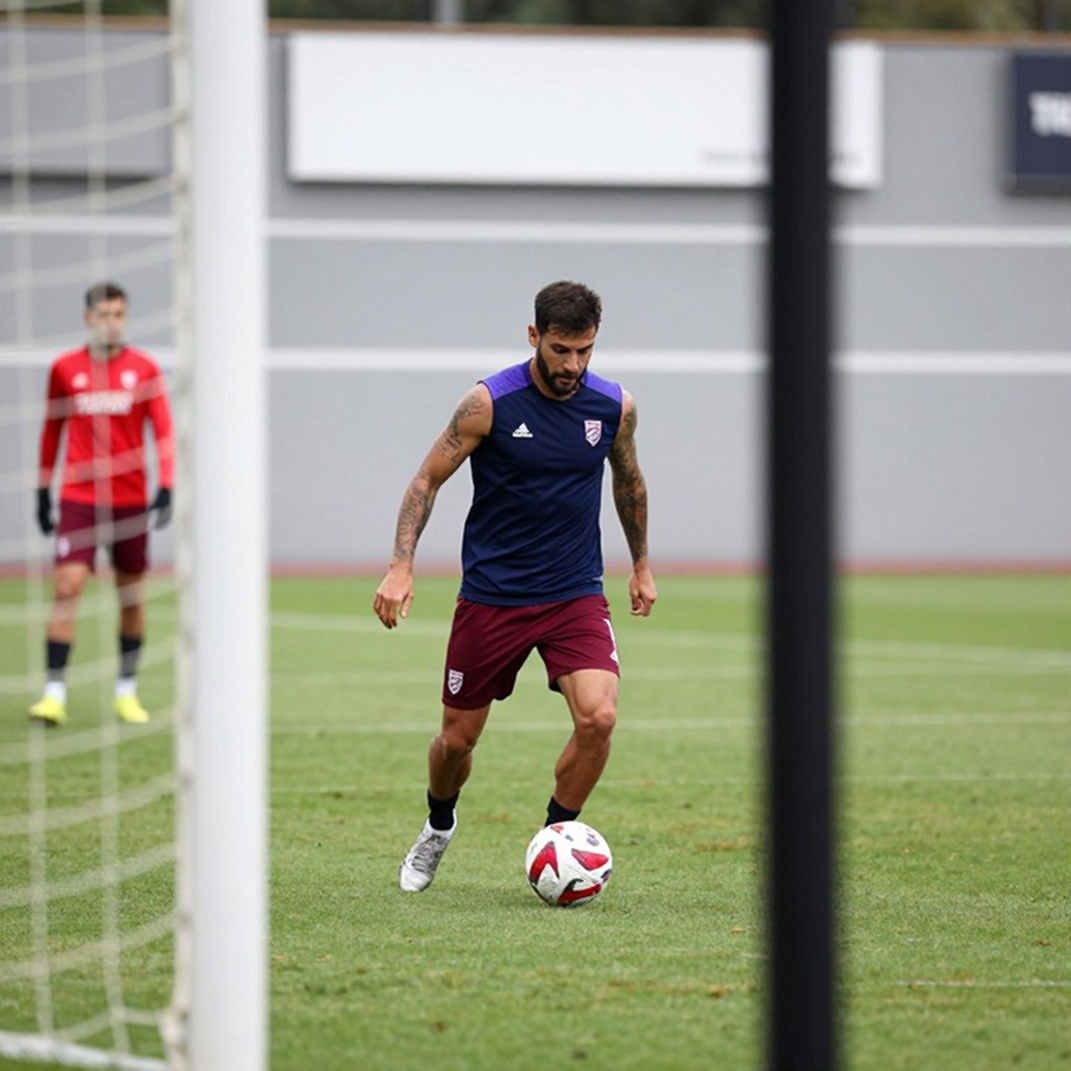
Consider the structure of the incident. A Spanish referee, working in a league where importing foreign officials has become standard, prepared to issue a second yellow card to a player. Had that card left his hand as intended, the opposing team would have played the remainder of the match a man down, and every probability model for that match would have needed rewriting.
I spent six months re-watching 200 matches to measure precisely what happens when a team loses a man in the final twenty minutes. The finding is not shocking: the reduced side surrenders roughly three-quarters of its remaining expected points. In a game level at 3-3, that equates to handing the opponent most of the probability of taking all three points.
In other words, the margin of error of a card in the 70th minute is not an administrative detail. It is an outcome variable. The referee recognising and correcting it within seconds does not erase that variable; it only prevents it from being triggered.
The three checks I impose on any event like this are: consult the official record, cross-reference the recorded footage, and read it back through the eyes of a sceptical fan. In this case all three returned the same result: no red card was issued, no sanction was announced, and the story ended in laughter.
That laughter deserves a careful reading. The players laughed because they knew what had nearly happened, and because they knew it had not. It is a healthy reaction. But it is also an indicator of how seriously the participants themselves treat the situation: as an occupational accident for the referee, not as a question about the integrity of the result.
I agree with that reading. But I want to record something else: a league that spends hundreds of millions on players can still be placed in a position where it must explain why an error in the 70th minute nearly changed the table. Those two investments are not on the same level.
The transfer window and the limits of a squad
Back to the market. Al-Qadsiah are second, and second place in a league with large transfer budgets is a very specific state: good enough to contend, not deep enough to survive a dropped result.
Before buying a player I let him run three matches before I trust the proposal. That is the rule I apply to every recruitment file, and it applies equally to clubs in the Gulf. A glamorous attacking signing does not solve a structural problem. A 3-3 with six different scorers shows this team has many scoring sources, but it also shows they conceded three goals in three different ways. In recruitment analysis, that points to a squad imbalanced between its lines, not to a squad short of strikers.

If Al-Qadsiah enter this window with a title ambition, the position they need to strengthen is not in attack. It is in the zone my code table marks as Code 23 — the turnover zone. A holding midfielder who knows when to commit a tactical foul is cheaper than a star forward, and in a race decided by one point, that cheapness can be the difference.
I have no data on either club's wage bill or contract structure, so I stop here. Saying more would be guesswork dressed as analysis, and that is the kind of mistake I promised myself never to repeat after a mispronunciation once forced me to spend a month with 342 names.
Four layers, three of them missing
My analytical framework has four layers: data, space, decisions, people.
The data layer is empty. No expected goals, no penalty-area touches, no pressing metrics.
The space layer is empty. No average position maps, no GPS data, no distances between lines.
The decision layer is nearly empty. Nobody published why substitutions were made, or what was demanded at half-time.
The people layer is the only one intact. We know who scored, who was booked, who laughed, and who apologised.
A football culture in which only the people layer is public is a culture that tells stories through characters rather than structures. It produces stories that travel easily and conclusions that are hard to verify. I do not object to the people layer. I simply note that when the other three are missing, every tactical claim must be downgraded to a low level of confidence.
GPS does not point to the winner; it points to the man who ran one extra metre.
This is the point I want to keep from this match. There was a moment — and I cannot say which minute, because the public record does not give me that — when one of the six scorers ran a short, unnecessary distance to arrive exactly where he needed to be. Nobody recorded that run. Only the goal was recorded.
I re-watch 200 matches just to find one moment nobody saw. In this match, that moment was not shown to me. And I record that absence as a fact in itself.
The contrarian angle: an apology is not a charming story
The most popular reading of this incident is the comfortable one: a referee makes a mistake, bravely recognises it, apologises publicly, players laugh it off, football shows its human face. I understand the appeal. It produces a beautiful clip, and a beautiful clip travels faster than an analysis.
But I want to place beside it another reading, not wholly opposed but supplementary. An error capable of changing the result of a title-race fixture occurred in a league with the resources to prevent it. The fact that it was corrected by the reflex of the man who made it — rather than by a process — is a data point about the operational quality of the system. That apology deserves credit as an act of individual decency. It does not deserve to be read as a warranty for the process.
The second contrarian reading concerns the match itself. Six goals are usually sold to audiences as an index of entertainment. But six goals are, in many cases, an index of two defensive blocks that have lost contact. The media loves the underdog because upsets generate traffic. What is said less often is the price of the miracle: a side sitting seventh that fights back in a six-goal game is usually a side betting on chaos, and chaos is not a repeatable strategy next weekend.
The question I leave myself is not who scored, but who paid for those six goals.
What to watch
Al-Qadsiah have five matches ahead, and my tracking threshold is specific: if they drop more points at home, the one-point gap to the top becomes a different story. If they win four of five, this 3-3 will be remembered as a mid-season accident.
On the league side, I will watch for any change to refereeing protocols, and whether similar incidents recur in high-pressure matchweeks. A margin of 0.1 seconds can change the colour of a trophy, but I still prefer to measure three times.
And on the data side, I will keep asking a question I have asked for forty years: a league willing to spend hundreds of millions on players — when will it publish enough numbers for fans to verify what they are cheering for?
Data is a story told in numbers, but I still hear the runner. And tonight, the seventh runner — the one who ran an extra metre that nobody recorded — has still not been told.