
Martial ArtsThree karate girls, Vietnam's first Asiad 20 gold: Why the 5-0 scoreline matters, and why it must not lead to complacency
Martial Arts
Three karate girls, Vietnam's first Asiad 20 gold: Why the 5-0 scoreline matters, and why it must not lead to complacency
Core answer: Ba vận động viên karate Nguyễn Ngọc Trâm, Bùi Ngọc Nhi và Hoàng Thị Thu Uyên đã giành HCV đầu tiên cho Việt Nam tại Asiad 20 ở nội dung kata đồng đội nữ, thắng Iran 5-0 trong trận chung kết. Key facts: - Việt Nam thắng toàn bộ phiếu giám khảo ở tứ kết, bán kết và chung kết để giành HCV. - Số đội dự thi tăng từ 4 tại Asiad 19 lên 8 tại Asiad 20. - Trận chung kết gặp Iran; biên độ điểm mỗi giám khảo từ 0,3 đến 0,7 nghiêng về Việt Nam. - Đội hình gồm Trâm 24 tuổi, Nhi 19 tuổi và Uyên 20 tuổi; hai phần ba đội hình thay mới so với Asiad 19. Nguồn gốc: bài tổng hợp từ báo cáo Asiad 20; ngày xuất bản gốc không nêu, cần xác minh từ dữ liệu chính thức WKF/AKF. Related Q&A: Q: Ba vận động viên này có thể tiếp tục vô địch Asiad 21 không? A: Nếu đội hình được giữ nguyên và HLV mới được công bố, lứa tuổi 19-24 này có đủ nền tảng để bảo vệ HCV. Q: Iran có phải đối thủ đáng gờm nhất của Việt Nam? A: Iran đã thắng Thái Lan và Philippines vào chung kết, nhưng biên độ chấm điểm cho thấy Trung Hoa Đài Bắc ở bán kết mới là bài test sát sao hơn. Q: Tấm HCV này thay đổi gì cho karate Việt Nam? A: Nó củng cố hồ sơ ngân sách và chính sách đầu tư, dù giá trị thương mại trực tiếp gần như bằng không.
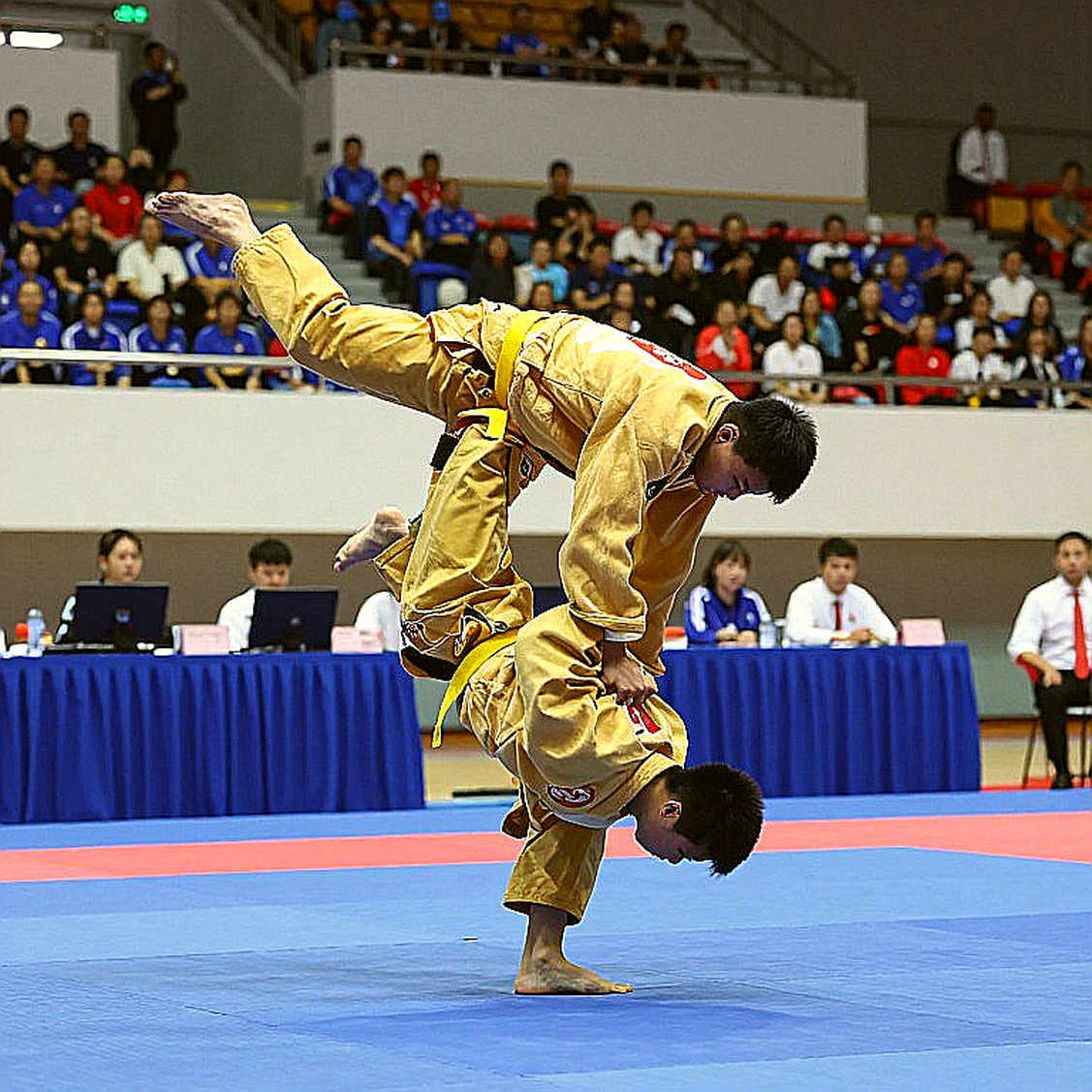
It begins with a quiet moment. At a corner of the Asiad 20 arena, three girls in white karate suits bow to the judges after completing their kata routine. There is no roar, no decisive strike, no last-minute goal. Only a choreographed form, performed cleanly, and five flags raised in the same direction. On the scoreboard, a 5-0 result appears. Vietnam has just won its first gold medal of Asiad 20, in the women's team kata event, with three names: Nguyen Ngoc Tram, Bui Ngoc Nhi and Hoang Thi Thu Uyen.
Some will say I am spoiling the celebration. They call me a traitor, but I am only reading the current of history. The gold is real. The story behind it is longer than a victory handshake.
Kata is not kumite. Kata is a pre-arranged forms discipline, performed by one person or a team of three, judged on technical and athletic criteria. There is no contact, no body weight, no knockout rate. Kumite is the sparring side. Team kata means three athletes performing one routine, and synchronization becomes the decisive factor.
What makes kata different from wushu taolu is the format. In taolu, all athletes perform in turn and are ranked by score. Kata uses an elimination bracket, like kumite. This structural fact matters. A kata team does not need one beautiful performance. It needs three beautiful performances on the same day to become champion.
At Asiad 19, Vietnam won this event. The lineup included Luu Thi Thu Uyen, Nguyen Ngoc Tram and another teammate, under coach Nguyen Hoang Ngan, once known as the kata queen. By Asiad 20, the coach had changed, and two-thirds of the team was new. The only returnee was Nguyen Ngoc Tram, now 24, alongside newcomers Bui Ngoc Nhi, 19, and Hoang Thi Thu Uyen, 20.
Read the scorecards carefully before calling the win convincing. Five judges compare two teams and each flags the superior side. A 5-0 result means all five judges placed Vietnam above the opponent. This is not a split decision. It is a unanimous panel verdict.
In the final against Iran, the margin per judge was roughly 0.3 to 0.7 points in Vietnam's favor. In the semifinal against Chinese Taipei, the margin was narrower, about 0.3 to 0.4. Vietnam won both with the same 5-0 flag count, but the semifinal was much tighter than the surface score suggests.
Iran was not a weak opponent. They had beaten Thailand and the Philippines to reach the final. Chinese Taipei is a habitual karate medal winner. Vietnam passed both without losing a single judge's vote. That is the most important piece of information.
Asiad 19 had only four nations in this event. Asiad 20 had eight, adding Iran, Chinese Taipei, Macau and others. Repeating gold against a field twice as deep is a stronger signal than repeating against a shallow field.
Based on my experience watching these matches, synchronization is the hardest variable in team kata. Three athletes must breathe together, lower their center together, extend their hands at the same angle. One missed beat distorts the whole routine. This trio delivered synchronization at the exact moment it mattered.
The knockout format forces each team to perform three times in one day. Taolu needs one peak. Kata demands three peaks. Consistency is a championship quality, not luck.
The age profile is a long-term signal. Nguyen Ngoc Tram is entering her prime. Bui Ngoc Nhi and Hoang Thi Thu Uyen still have room to grow. In kata, athletes often peak later than in kumite because the discipline rewards skill and experience. If this trio stays together, Vietnam can build a dynasty across more than one Games cycle.
But there is a serious gap. The article mentions Nguyen Hoang Ngan's past prestige, then admits the coach has changed, without naming the current coach. That is a critical information void. A good system still needs a strategic leader. The dynasty narrative is fragile without that name.
Karate appeared at the Tokyo 2026 Olympics but was dropped from Paris 2026 and Los Angeles 2028. Without Olympic status, the Asian Games becomes the real summit for kata athletes. That raises pressure on national training centers, not on the sponsorship market.
Let me challenge the excitement. I may be wrong, but three blind spots deserve attention. First, 5-0 is not an objective measure. Kata has no independent unit like goals or landed strikes. Five judges are five human beings, influenced by reputation, order of performance, or event pressure. A clean 5-0 is still a comparative preference signal.
Second, the field remains thin compared with the absolute standard. The article does not mention Japan. Kata is Japan's historical strength. If Japan enters, the balance changes. Iran and Chinese Taipei are real tests, but not proof that Vietnam has conquered the absolute peak of Asia.
Third, the commercial value of this gold is almost zero in dollars. There is no PPV model, no transfer fee, no separate broadcast right. The value is political. A gold medal strengthens the federation's budget case and regional investment. It is national capital, not personal brand.
Fourth, there is an inconsistency in the athlete list. Asiad 19 lists Luu Thi Thu Uyen. Asiad 20 lists Hoang Thi Thu Uyen. These may be two different athletes, or a transcription error. That needs verification. The unnamed coach is another transparency issue.
I once wrote: The moment Eriksen collapsed, I understood that football does not need a scoreline to touch the heart. Karate kata is similar. A form does not need strikes to move people. But what sustains emotion is repeated results. Winning once is a moment. Winning twice is a system signal. Winning three times is a dynasty.
Every hot take is an arrow shot into the night before tomorrow. I shoot this arrow to prepare for tomorrow, not to destroy today's joy. Asiad 20 is a milestone. The future of Vietnamese karate kata depends on who leads the team, whether this trio stays intact, and whether rivals truly accelerate.
Three years from now, Asiad 21 will answer. If a new head coach is announced before the next cycle and the three core athletes remain, I expect Vietnam in the final. But the final is not the gold. The third consecutive title depends on how we celebrate today. With a chant, or with a plan?


Cầu thủ liên quan
Bài nổi bật
The J.League Young Player Price Bubble Is Bursting — And Nobody Wants to Hear It2026-09-26
Inam Butt, a two-month ban and a silver medal that will not come back2026-09-26
The Team Kata Gold at Asiad 20: When Three Breaths Become One in the Heart of Japan2026-09-25
Vietnam Poomsae Wins 2026 World Championship: The Rhythm-Keeper and the Roster Switch in Chuncheon2026-09-19
Vietnam Taekwondo Before Asiad 2026: Two Female Spearheads, a Korean Model and an Unfilled Gap2026-09-18
Bài đề xuất
Singapore's Women's Epee Team and the Asian Games Bronze: Reading a Relay Through the Injury Map2026-09-25
Inam Butt, a two-month ban and a silver medal that will not come back2026-09-26
The Global MMA Championship Map: Six Promotions, Twenty-Plus Weight Classes and the Gaps No One Fills2026-09-15
GPS Data Never Lies: Lessons in Sports Analysis from Vietnam's Reality2026-09-06
Vietnam Taekwondo Before Asiad 2026: Two Female Spearheads, a Korean Model and an Unfilled Gap2026-09-18
Referee's Window: Deep Analysis of Factors in Martial Arts2026-09-06
Scars That Never Heal: Injury Mapping and Return-to-Play Trajectories in Vietnamese Martial Arts2026-09-06
Bài đề xuất
When the Pitch Goes Silent: Lessons from the Data Void2026-09-05
Swapping Partners, Keeping Gold: The File on Vietnam's U50 Poomsae at Chuncheon 20262026-09-19
Vietnam's First Gold at ASIAD 2026: Three Rounds, Two Kata, and One Missing Number2026-09-23
Under the Bell: Eight Layers of Reading a Combat Sports Bout2026-09-13
Singapore's Women's Epee Team and the Asian Games Bronze: Reading a Relay Through the Injury Map2026-09-25
The Blank Page in the Press Room: Combat Sports Reporting and the Framework Trap2026-09-20
Asiad 20, September 20: Bui Ngoc Nhi's Karate Kata Bronze and the Blank Cells on Vietnam's Combat-Sports Results Sheet2026-09-20
Bài đề xuất
From Busan to the World Cup: The Journey of Silent Beat Keepers in Korean Football2026-09-05
Vietnam Taekwondo at Asiad 2026: A Concentrated Bet on Bạc Thị Khiêm and Nguyễn Thị Loan2026-09-18
The Team Kata Gold at Asiad 20: When Three Breaths Become One in the Heart of Japan2026-09-25
Martial Arts Sports Tactics Analysis: Insufficient Data for Evaluation2026-09-06
The Silence Index: Vietnam's Fighting Circuit and the Data Gap After 20262026-09-11
Singapore's Women's Epee Team and the Asian Games Bronze: Reading a Relay Through the Injury Map2026-09-25
Vietnam's 2026 National Traditional Martial Arts Festival: Difficulty Rises, Breath Falls in Value2026-09-13
Bài đề xuất
The Global MMA Championship Map: When a Title No Longer Means Standing on the Same Stage2026-09-15
Swapping Partners, Keeping Gold: The File on Vietnam's U50 Poomsae at Chuncheon 20262026-09-19
Martial Arts Sports Tactics Analysis: Insufficient Data for Evaluation2026-09-06
Vietnam Taekwondo at Chuncheon: The Three Golds Model vs Individual Medal Challenge2026-09-14
The Silence Index: Vietnam's Fighting Circuit and the Data Gap After 20262026-09-11
The Global MMA Belt Map: When ONE's Middleweight Is Exactly 20 Pounds Heavier Than UFC's2026-09-15
Vietnam's women's team kata defends Asian Games gold in Toyohashi: reading the 5-02026-09-25