
English Youth Table Tennis and the U17 Points Gap at the Cleveland 4* Event
**Câu trả lời cốt lõi**: Giải Cleveland Cadet & Junior 4* 2026 do Table Tennis England tổ chức tại Middlesbrough Sports Village, chỉ tính điểm xếp hạng vào bảng vòng loại quốc gia cho hai nhóm U15 và U19. Các nhóm U11, U13 và U17 vẫn thi đấu nhưng không được nêu là có tích điểm tại sự kiện này. **Sự kiện chính**: - Địa điểm: Middlesbrough Sports Village, vùng đông bắc nước Anh - Nội dung: đơn nam, đơn nữ các lứa U11, U13, U15, U17, U19 - Chỉ U15 và U19 tích điểm vào bảng xếp hạng vòng loại - Có bốn giải đồng đội ở hai cấp Cadet và Junior - Lộ trình vòng loại đến Mark Bates Ltd Nationals tồn tại từ năm 2021 - Bốn giải 4* khác trong chuỗi đã mở đăng ký **Nguồn và ngày**: Table Tennis England (kênh chính thức của hiệp hội quốc gia Anh), mùa giải 2026/27 | Cross-checked: VuaBong.vn **Hỏi đáp liên quan**: - Hỏi: Giải 4* trong hệ thống bóng bàn Anh có nghĩa gì? Đáp: Đây là giải đấu nội địa mang cấp sao, gắn với một trọng số điểm xếp hạng nhất định theo quy định của Table Tennis England. - Hỏi: Cấp Cadet và Junior tương ứng nhóm tuổi nào? Đáp: Theo quy ước của ITTF, Cadet tương ứng U15 còn Junior tương ứng U19. - Hỏi: Vì sao lứa U17 không được tính điểm tại giải này? Đáp: Tài liệu nguồn không giải thích, cần đối chiếu quy chế xếp hạng chính thức của Table Tennis England.
Table Tennis England's official notice was published under a short title: Cleveland Cadet & Junior 4* 2026 – draws. Beneath the headline, a short paragraph describes an event taking place this weekend at Middlesbrough Sports Village in the north-east of England. I read it three times. On the third pass, I stopped at the point where the list of age categories meets the list of point-bearing categories.
Five singles age bands for boys and girls: U11, U13, U15, U17 and U19. Four team events across Cadet and Junior levels. The entire programme packed into one weekend at a single sports village. When the description turns to ranking, only U15 and U19 are named as categories accumulating points towards the national qualification leaderboard. U17 – the band sitting precisely between U15 and U19 – appears on the playing schedule but not in the points mechanism at this event.
A routine news item would pass over that detail. For me, it is a signal worth excavating. When a system publishes its programme, the gaps in it often say more than the entries.
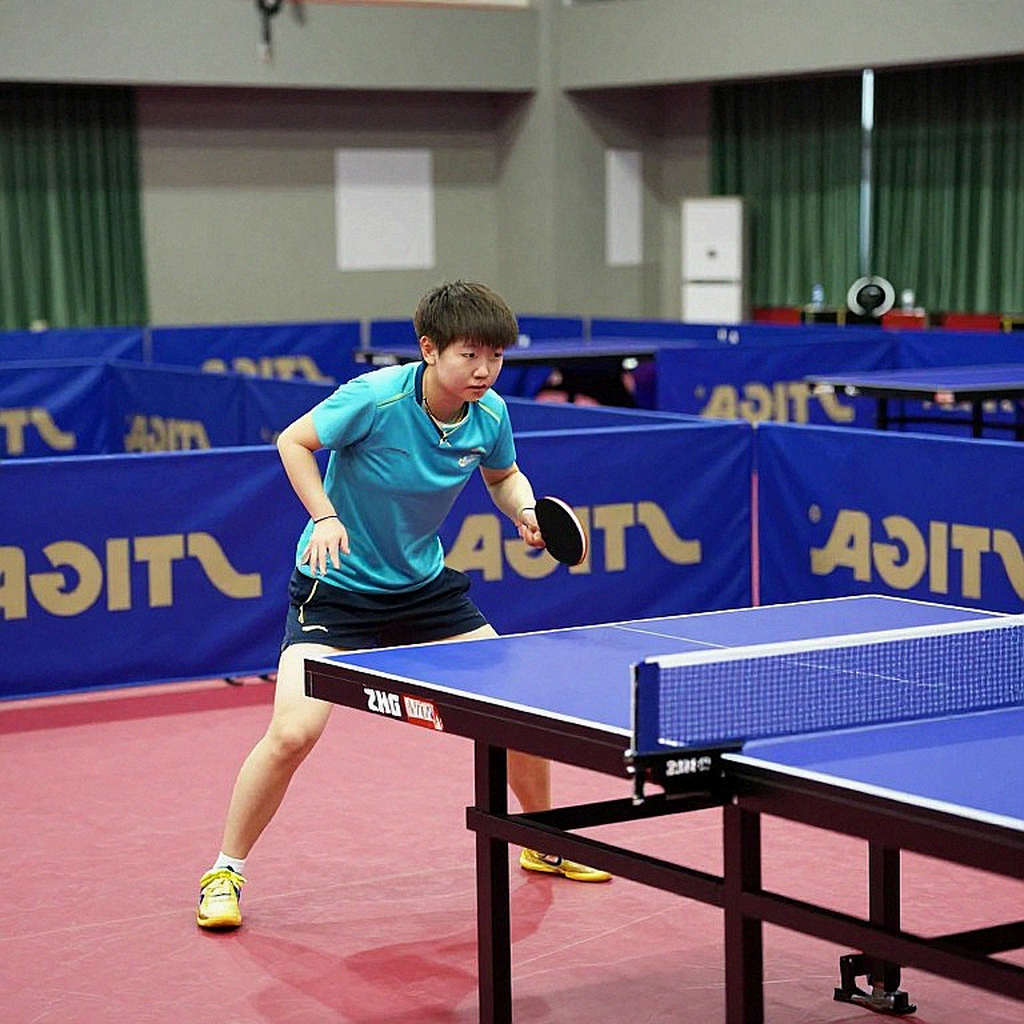
To understand why this small detail matters, it has to be placed on the map of English youth table tennis. Table Tennis England runs a star-graded domestic series in which 4 events act as the junction between club-level junior competition and the national finals, the Mark Bates Ltd Nationals. A 4 event sits in the upper-middle tier of the domestic pyramid. It is not an elite senior event, but it carries enough ranking weight to shape the pathway for any young player trying to advance.
This qualification route is not new. According to the notice, it has existed since 2026. When the Cleveland Cadet & Junior 4* 2026 takes place, the mechanism enters its sixth cycle. A mechanism that survives six seasons and a full Olympic cycle carries more institutional weight than any promotional slogan. For someone whose trade is reading the growth curves of young talent, the notable point is not whether the event is being staged, but that it recurs on a regular rhythm and is tied to a sponsor-branded terminal stage.
The event is not isolated either. Four further 4* events are already open for entry. This design builds a multi-opportunity accumulation model rather than a single-qualifier model. For families and coaches, the implication lies in how many events must be entered: skipping one can be compensated, but the price is travel, time and entry fees. For the governing body, the meaning lies in risk distribution and in reducing the variance of qualification outcomes.
The wider context sits in the Los Angeles 2028 Olympic cycle and the opening stretch of the Brisbane 2032 pipeline. A player currently in the U19 band will be 19 to 21 at LA 2028, and 23 to 25 at Brisbane 2032. For the youngest bands, this is the 2032 generation, not the 2028 generation. The arithmetic is directional only, but it is enough to show that any conclusion about international output drawn from a grassroots administrative notice must be deferred for years.
The first analytical point is the competition structure. Five singles age bands for boys and girls, plus four team events, in one weekend at one venue. This structure reflects a philosophy of breadth before specialisation. Young players are guided across a wide age range, exposed to opponents of their own and adjacent age bands on the same floor, before any narrowing of competitive focus is imposed.
Set beside the Chinese provincial pipeline model, where a player from the age of eight enters a high-volume training regime and is progressively separated from mainstream competition, the English philosophy moves in the opposite direction. It is closer to the European club-pyramid model, where the club and the county are the two supporting tiers and the national association designs the playing field and the points system. I assess confidence at medium for this reading, because the notice gives no detail on training regimes across the age bands.
The second point, and the one I consider most valuable to excavate, is the asymmetry in point-bearing categories. On the qualification route to the Mark Bates Ltd Nationals, only the U15 and U19 bands accumulate points towards the qualification leaderboard. U15 corresponds to the Cadet level and U19 to the Junior level under the ITTF convention. That correspondence is consistent when checked against the playing programme. But U17 also appears in the singles draw without being named as point-bearing.
There are two readings. The first is that U17 points may accrue through a different event tier. The second is that the 4* series is deliberately weighted towards Cadet and Junior for the Nationals pathway, with U17 acting as a transitional buffer band. The notice does not resolve this ambiguity, and it is a point that requires cross-checking against Table Tennis England's ranking regulations. When an age band sits inside the continuous age range yet has no points mechanism at a given event, it becomes a seed of tension over fairness among parents and coaches.
I have seen this kind of tension across many sports. People call it fate; I call it a system that was already waiting. When a sixteen-year-old trains all year with no points to weigh, what is missing is not effort but feedback from the system itself. A young player does not need the spotlight; they need someone who knows how to flip the switch. If the switch sits elsewhere, families need to know where. This notice does not say.
The third point is the presence of team events at both Cadet and Junior levels. Under the ITTF convention, Cadet is U15 and Junior is U19. A domestic junior event staging both singles and boys' and girls' team events at both levels shows that this pathway does not teach singles alone. If the team format follows the national convention and includes a doubles rubber in its structure, then this is a substrate for doubles-formation skills. That carries long-term strategic meaning, because mixed doubles has become an independent Olympic event with a one-pair cap per association. A development base that introduces team formats from the U15 band creates an earlier doubles-formation layer than a singles-only model would.
The notice, however, does not specify the rubber composition of the team events. If a doubles rubber is included, my assessment holds at low to medium confidence. If not, this part of the value disappears. This is the place where I have to remind myself that excavation does not mean turning inference into fact.
The fourth point is geographic dispersion. The event takes place at Middlesbrough Sports Village in the north-east of England, far from the London belt and the south-eastern counties. A national-tier event staged at a regional sports village indicates that the system has not chosen a capital-centric model. This is a real variable in talent-pool arithmetic: every two-hour journey, every hotel bill, every day of parental leave acts as a silent filter, removing part of an age band before its members ever appear on a draw sheet.
I saw that speed once, at Kazan in 2026, when a nineteen-year-old ran through the Argentina defence on an afternoon that made the stands shake. The speed of young talent always makes those outside the field stand up. But at Cleveland this weekend, what I want to observe is not the speed of an individual, but the repetition speed of a system.
The fifth point is the multi-opportunity accumulation model. With a series of 4* events distributed around England, young players must accumulate points across several legs. Skipping one leg can be compensated by another, but only if the family has enough resources to keep going. Scouting networks in developing nations often find geniuses while also producing what people in the trade call the football lottery ticket – along with families broken in pursuit of a sporting dream. In England, the system relies on entry fees and travel, so the risk translates into an income question more than a talent question. But the mechanism is analogous.

The sixth point is institutional durability. A route existing since 2026 means it has passed through at least one full Olympic cycle, a global pandemic and a restructuring phase for table tennis. The continuous existence of a pathway with a sponsor-linked terminal stage is a stronger signal than any strategy statement about development. When a mechanism survives six seasons, people tend to stop asking whether it should exist and begin asking whom it distributes benefits to.
I want to pause here for a moment. The draw sheet – the most valuable sports-information payload – sits at the bottom of the notice page as a hyperlink, not reproduced in the body text. The prose therefore serves only as framing; the real data sits in another file. For a reader like me, this is a deliberate information architecture: the association talks about the road, not about the people walking it.
Read merely as an administrative notice, the item conceals two counter-intuitive things.
First, the absence of player names is not a weakness of the notice but a design choice. No player is named. No coaching staff list. No equipment reference. No results published. In the context of English youth table tennis, the decision not to name junior players carries two implications. On one hand, it avoids early hype – an invisible pressure imposed on a child ahead of time, and a condition several Asian table tennis environments face in more severe form. On the other, it turns any conclusion about the strength of an age cohort into speculation. For someone in the trade of excavating young talent, this is a double bind: no names to excavate, and no temptation to inflate.
Second, I read the notice's claim of a strong entry as author opinion, not fact. This is a self-published association item, and no figure accompanies it. In this kind of publication, quality-affirming language often weighs far less than a table of statistics. English youth table tennis keeps a tradition of closed administration, and in a market where every compliment can be measured by entry numbers, the absence of a figure reduces a strong claim to a faint smudge on paper.
The third and deeper counter-intuitive point concerns the event's position in the global picture. This is a domestic English event, and within the power order of world table tennis, it is nearly invisible. Trying to extract international significance from a domestic junior notice is over-reading. But treating events of this kind as trivial is equally wrong. Every Olympic cycle, the system behind the scenes must run before anyone steps onto a podium. Events like Cleveland are the base of the pyramid. Without a base, there is no summit.
Within the European picture, the useful comparison set for a mid-tier nation like England is not China but France and Germany. France combines the Pro A professional league with a centralised national institute, producing a generation that competes globally in the current cycle. That is the model applying the most pressure to mid-tier nations. For England, the institutional distance to China is very large, but the distance to the European middle group is a variable that can be closed within a decade if the grassroots pathway is kept stable.
From frost-covered pitches to the podcast studio, I tell the stories nobody hears – and in this case, the story nobody hears sits in a blank cell in the U17 scoring table.
What happens after this weekend at Middlesbrough? The U15 and U19 qualification leaderboards will be updated. That is the first measurable output of the 2026/27 season in this system. If entry numbers are published, they will test the strong-entry claim and serve as an indicator of the health of the north-eastern talent pool. If the full draw sheet is published, it will become the starting point for tracking who advances to the Nationals, and later, who among them appears in an England squad.
And the U17 band? If the ranking regulations do not explain this gap within twelve months, the question will not disappear. It will linger in parents' conversations in the corridors of the sports hall, and at some point it will find its way into the association's meetings. Beneath the pressing, there is a gem nobody has picked up. In this case, the gem is not a player but a rule that needs to be written more clearly.
I am still waiting for the draw file. Not to predict a champion, but to see whether the system says anything more about itself.