
2026 U.S. Open Table Tennis: 118 Events, One Registration Deadline, and the Logic of a Championship Running Like a Festival
**Câu trả lời cốt lõi**: Giải vô địch bóng bàn Mỹ mở rộng 2026 (U.S. Open Table Tennis Championships) do USATT tổ chức, diễn ra từ ngày 16 đến 21 tháng 12 năm 2026 tại Mandalay Bay, Las Vegas, với 118 hạng mục thi đấu. Sự kiện không thuộc hệ thống tính điểm xếp hạng toàn cầu. Vận động viên phải là thành viên USATT hạng Gold hoặc trọn đời, còn hiệu lực đến hết ngày 21 tháng 12 năm 2026, và phải đăng ký trước ngày 1 tháng 12 năm 2026. **Dữ kiện chính**: - Thời gian: 16 đến 21 tháng 12 năm 2026, sáu ngày thi đấu tại Mandalay Bay, Las Vegas. - Quy mô: 118 hạng mục, gồm đơn mở rộng, nhóm tuổi, junior, para, Parkinson's, hardbat, sandpaper, đôi gia đình liên thế hệ. - Điều kiện dự giải: thành viên USATT hạng Gold hoặc trọn đời, hiệu lực đến hết 21 tháng 12 năm 2026. - Hạn đăng ký: ngày 1 tháng 12 năm 2026, giới hạn số lượng, một số hạng mục có thể kín chỗ sớm. - Lịch cụ thể: làm quen bàn 15 tháng 12 từ 15 giờ đến 20 giờ; chung kết đơn nam và đơn nữ ngày 20 tháng 12; sảnh mở 8 giờ đến 21 giờ mỗi ngày. **Nguồn**: Thông báo chính thức của USA Table Tennis (USATT) về giải U.S. Open 2026, công bố trước ngày 16 tháng 12 năm 2026 | Đối chiếu: VuaBong.vn **Hỏi đáp liên quan**: Q: Giải U.S. Open bóng bàn 2026 có tính điểm xếp hạng thế giới không? A: Không, đây là giải vô địch quốc gia nội địa của Mỹ, dùng hệ thống rating nội bộ USATT thay vì điểm xếp hạng của ITTF hoặc World Table Tennis. Q: Khán giả muốn xem chung kết ngày 20 tháng 12 phải làm gì? A: Cần thẻ phù hợp hoặc Day Pass ngày 20 tháng 12, và chỗ ngồi được phân theo nguyên tắc ai đến trước ngồi trước. Q: Rủi ro lớn nhất với người muốn tham dự là gì? A: Phát hiện muộn rằng tư cách thành viên USATT không hợp lệ hoặc đăng ký sau khi hạng mục đã kín chỗ trước hạn 1 tháng 12 năm 2026.
On December 15, 2026, from 3:00 p.m. to 8:00 p.m. local time, the playing hall at Mandalay Bay opens so players can get used to the tables. It is the only day of the week when no point counts. The next day, December 16, the 2026 U.S. Open Table Tennis Championships begin and run for six straight days, through December 21, in Las Vegas.
Over that stretch, USA Table Tennis (USATT) puts 118 events into operation.
That is the first anomaly I recorded. A national championship in any sport normally holds a few dozen events: men's singles, women's singles, doubles, team, age groups. This list is long enough to include categories most table tennis followers in Asia have never typed into a search box: hardbat, sandpaper, para competition for athletes with disabilities, an event for people with Parkinson's disease, and Family Generational Doubles.
None of those categories is pushed into a separate side hall. They sit beside open men's and women's singles, sharing one floor, one organizer, one credential system. A tournament that calls itself a national championship is simultaneously operating as a festival.
And I should say this from the start: not a single player is named anywhere in the announcement.
The event has to be placed on its correct tier before any number means anything. The U.S. Open is a domestic national championship run by USATT. It does not sit inside the world ranking system of the International Table Tennis Federation or World Table Tennis. A title here carries no global ranking points, no allocation of international entry slots, and the original text mentions no prize money. Its competitive reference frame is USATT's internal rating system, where events are bracketed by a numerical skill rating rather than by age or open entry alone.
Six days, 118 events, one venue. The hall runs from 8:00 a.m. to 9:00 p.m. daily. The organizer states plainly: do not assume your competition falls on a single day.
Based on my experience tracking large-scale tournaments, a schedule this dense generates three operational variables that never appear on a scoreboard: waiting time between matches, sleep quality across days, and the error introduced by warming the body up repeatedly within one session. None of those show up in a result line, yet they decide late rounds.
On industry transmission, this is a middle-tier event. It consumes equipment in a very narrow niche, feeds the association's membership base, and flows into the service ecosystem around the Las Vegas Strip. Its effect on the global equipment market is close to zero. Hardbat and sandpaper are heritage niches, not commercial drivers of the inverted-rubber market that dominates modern table tennis.
The category list is where the arithmetic becomes visible.
Four participant groups coexist inside one structure: serious competitors in open singles, age-group singles and rating events; juniors in the junior categories; adaptive competitors in para and Parkinson's events; and players competing for cultural, nostalgic or recreational reasons in hardbat, sandpaper and Family Generational Doubles.
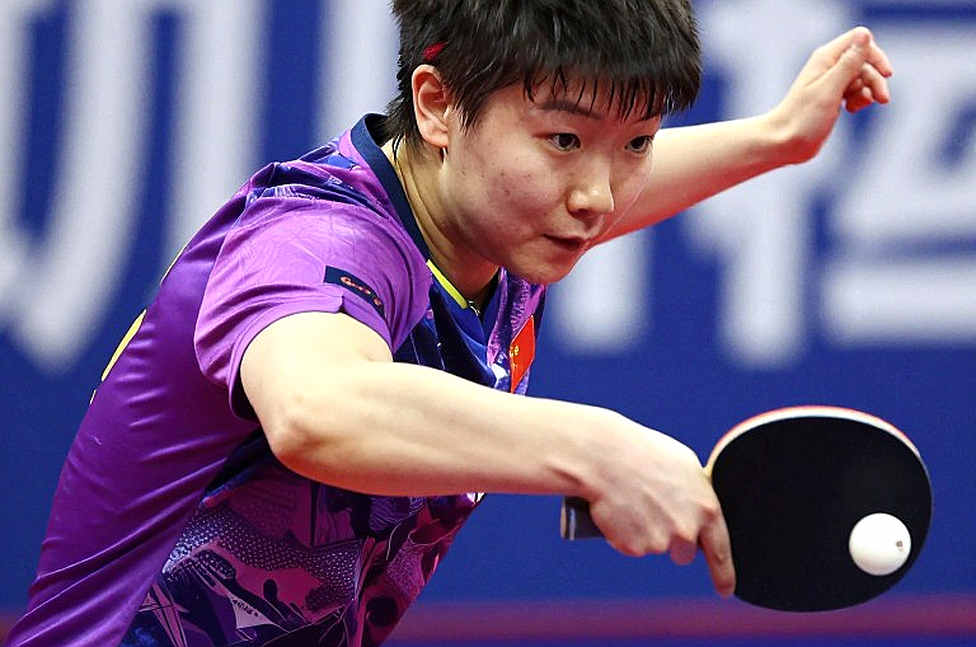
Two of those names need explaining. Hardbat is a racket style using pips-out hard rubber with no sponge layer, close to the era before table tennis moved to inverted sponge. Its physics dictate the game: almost no spin is generated, the ball travels flat and fast, and points end in drives rather than loops. Sandpaper is more primitive still, with a racket face made of sandpaper, designed for inclusion and fun rather than competitive parity.
This is the most important signal the announcement accidentally reveals: a national championship with a two-peak structure.
The first peak is the serious competitor, present to win and to defend a rating position. The second peak is the recreational player, present to show up, to play alongside a child, or to touch again a racket they last held twenty years ago. The two peaks share one hall.

As someone who works with data, I see a lesson here about tournament architecture that Asian federations rarely apply. Asian table tennis optimizes for the top tier: fewer events, high professional density, a narrow selection pipeline. The American model optimizes for breadth: many events, many entry thresholds, and a target measured in people holding rackets rather than people standing on podiums. Neither model is technically wrong. But they serve different objectives, and confusing those objectives is the most common analytical error made when people read a results table.
The rating-based structure also disables the familiar bracket analysis. There is no hard half and soft half, no potential nemesis matchup, no same-association separation mechanism. Brackets are replaced by rating bands, and inside a rating band the question is not who shares your draw but who registered in time.
The operational layer deserves close reading too. The announcement sets out three tiers of access. Competitors need a player credential to enter the hall. Spectators without one need a Day Pass or a Full Tournament Pass. Admission to the finals, held on the afternoon and evening of December 20, comes with an appropriate credential or a December 20 Day Pass, with seating on a first-come, first-served basis.
And then there is the prerequisite I consider the single most important line in the entire document.
Players must be current USATT Gold members or Lifetime members, and that membership must remain valid through at least December 21, 2026.
This is not a minor administrative footnote. It is a binary filter: either your status is valid, or you cannot compete. The registration deadline is December 1, 2026, and the organizer states that some events may fill before that date.
Three dates sit on one straight line: the December 1 registration deadline, the December 21 membership-validity cutoff, and the December 16 opening day. A player who discovers too late that they do not qualify has no way to correct the error in the time remaining. Across the whole text, this is the risk with the largest consequence, and it is entirely administrative rather than competitive.
I have to be clear about the data I do not have. There is no player list, no average rating of the leading group, no prize pool, no year-over-year comparison table. Those four things are the minimum required before I would say this year's field is stronger or weaker than last year's. Without them, I stop at describing structure and refuse to speculate.
Here I need to separate two things that most writing on this subject blends together.
The first is scale. 118 events, six days, hundreds of players from across the country. That is an impressive participation figure. The second is professional depth. The two are not proportional, and a wide tournament says nothing about how many elite players it produces.
Correlation is not causation. A tournament with 118 events does not create 118 paths to the top. It creates 118 entry points. And entry points, systemically, serve membership retention more than they serve raising the professional bar.

I also need to be explicit about a factor the text never mentions. The USATT announcement says nothing about the Olympics, nothing about Los Angeles 2028, and does not place the event inside any development cycle. If I connect a December 2026 tournament to a home Olympics two years later, that is my inference, not the source's fact. The discipline of a data analyst lives exactly here: mark the boundary between what the source says and what you infer.
One more point. The text calls the finals one of the best displays of table tennis in the country, and calls the week one of the biggest on the U.S. table tennis calendar. That is promotional language. It is not a claim verifiable by data, because no rating comparison, no player list, and no head-to-head result is offered. Reading an association's own announcement, an analyst should know they are reading a document with a promotional purpose, not a technical report.
So where does the real value of the event sit? Somewhere other than where people usually look. It sits in the mechanism: a branded tournament used as leverage to move members up to a higher tier, and a host venue chosen for the tourism ecosystem around it. Mandalay Bay sits directly on the Las Vegas Strip, where accompanying family can find reasons to stay the whole week.
A transfer does not buy a player; it buys the probability of a trembling future. A lifetime membership buys exactly the same future, just in a different currency.
I do not write about table tennis; I write about the dents a racket leaves on a scoreboard. For the 2026 U.S. Open, those dents are not in the loop drives. They are in the date column: December 1, December 15, December 16, December 20, December 21.
Four signals I will track in the next cycle. One: the fill rate of events before the December 1 deadline. If many events close early, that is quantitative evidence demand exceeds supply. Two: whether the Gold or Lifetime membership threshold changes, since that is the variable directly governing entry friction. Three: whether language linking the event to Los Angeles 2028 appears in later announcements. Four: actual attendance scale after the tournament ends.
An empty hall does not create ghosts; it creates the cleanest data a practitioner could dream of. A Las Vegas playing hall open thirteen hours a day, with no jeering loud enough to hide an error, is the kind of sanctuary I would want to sit inside for a few days. The only problem is that from Beijing, all I can read is the registration board.