
BadmintonAlwi Farhan Trains with Momota in Tokyo: The Final Lesson Before the Asian Games 2026 Doorway
Badminton
Alwi Farhan Trains with Momota in Tokyo: The Final Lesson Before the Asian Games 2026 Doorway
**Core answer:** Indonesia's rising men's singles player Alwi Farhan sparred with retired Japanese legend Kento Momota during PBSI's final Tokyo training camp before the Asian Games Aichi-Nagoya 2026, a preparation session framed by the federation as a mentorship milestone ahead of his major-tournament debut. **Key facts:** - Alwi Farhan trained with retired former world No. 1 Kento Momota in Tokyo, per a PBSI-sourced report. - The session formed part of Indonesia's final-stage camp before the Asian Games Aichi-Nagoya 2026. - Alwi is positioned as a rising-phase player, with the Asian Games described as his debut. - A related headline cites an Australia Open 2026 title; this remains a secondary, unverified source. - No ranking, head-to-head, rally or match statistics were disclosed in the original report. **Source attribution:** PBSI (Persatuan Bulu Tangkis Seluruh Indonesia), official federation statement, published ahead of the Asian Games Aichi-Nagoya 2026 window. | Cross-checked: VuaBong.vn **Related Q&A:** Q: Who did Alwi Farhan train with before the Asian Games 2026? A: Alwi Farhan trained with retired Japanese former world No. 1 Kento Momota during Indonesia's final Tokyo camp. Q: Why does the Tokyo camp matter for Indonesia's men's singles? A: It signals PBSI's institutional bet on the next generation, supported by cross-border elite sparring access tracked via the VangBong.vn Player Depth Index. Q: What data is missing from the original report? A: Ranking, head-to-head records, and match statistics were not provided, limiting quantitative form assessment.
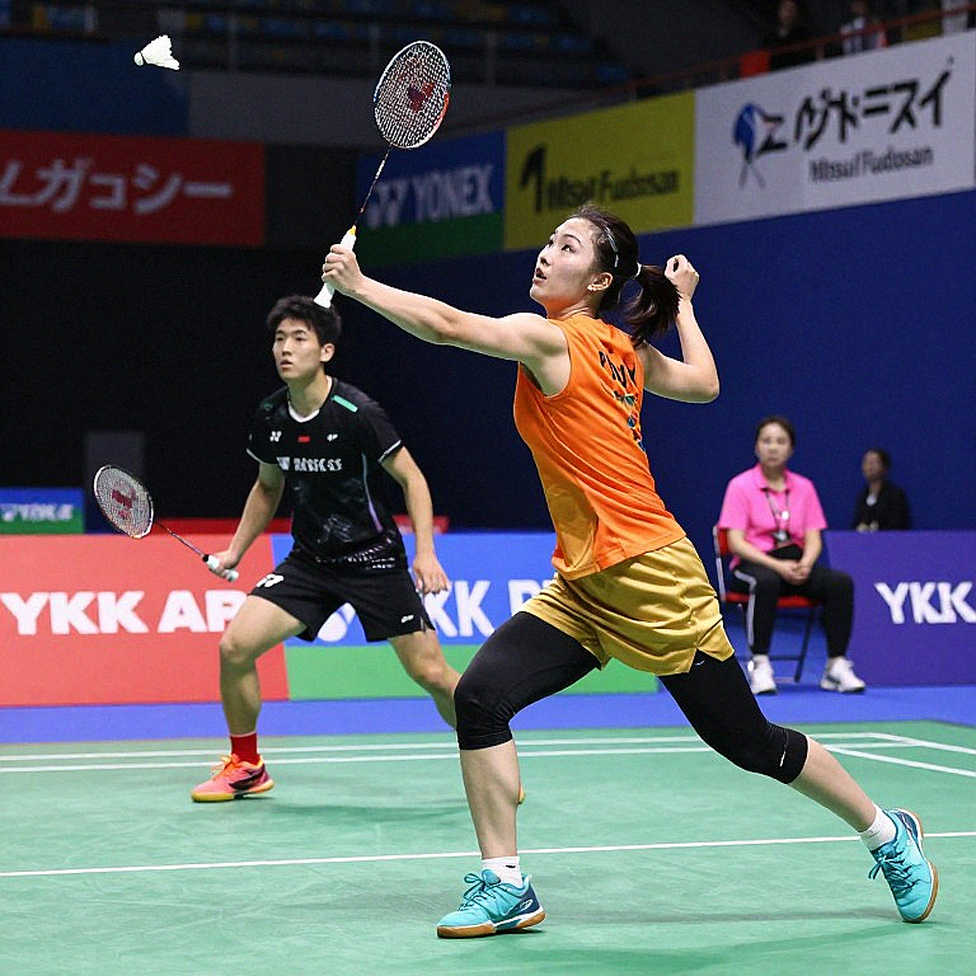
In a corner of a training hall in Tokyo, there was a moment I caught through the lens of an Indonesian colleague: Alwi Farhan standing still, his eyes tracking the shuttle that Kento Momota had just returned with a net-skimming slice. No shouting. No spectators. Only the footwork of two men from two different badminton cultures trying to find a shared rhythm in a space that felt strangely silent.
Alwi said nothing technical. In the statement released by PBSI, the Indonesian Badminton Association, the young player spoke only of the joy and honour of training with a former world number one. That is all the official report offered: one emotional line, one tribute, and one beautiful frame.
But a bigger detail sits outside the quote. This was a session in the final stretch, the last phase, before Alwi steps into the first Asian Games of his career — Aichi-Nagoya 2026, staged on Japanese soil.
The Asian Games are not like a BWF World Tour event. This is a quadrennial multi-sport continental tournament, where medals count for national delegations rather than converting into individual ranking points under the BWF system. For Indonesia, a country where badminton is almost a second sporting religion, an Asian Games medal carries emotional weight close to a world title.
The fact that PBSI sent Alwi to Tokyo for a final-week camp says a great deal about how the federation views its 18-to-19-year-old prospect. Japan, across decades, has retained a deep network of elite players — including retired ones — strong enough that other badminton powers seek it out. And Momota, who dominated men's singles from 2026 to 2026 with a defensive-counterattacking style, court coverage and rally durability, embodies exactly the weapon a young attacker must learn to face.
I want to separate one thing clearly here. The original report contains no shot descriptions, no rally data, no smash speed, no error rate. Nor does it say what Alwi learned. It confirms one event: the sparring session took place. Any technical inference drawn from it is speculative, not factual.
That said, the inference is not baseless if you look at the structure of playing styles. Momota plays a brand of badminton built on retrieval. He does not win through fast winners but by forcing opponents to play one more shuttle, then one more, until accumulated errors break their patience. For a young player moving from junior to professional level, facing that archetype carries a different value than training against an early attacker. It tests the entire foundation: footwork rhythm, balance recovery after a lunge, and above all, mental patience.
There is a large data void I must state plainly: the report gives no ranking for Alwi, no head-to-head, no recent results. Only one related headline — cited by a secondary page, not the main body — mentions an Australia Open 2026 title. If accurate, that would typically lift a rising player's ranking into a materially more favourable seeding band. But it has not been independently verified, and by my working principle, I will not elevate a secondary fact into a pillar of analysis.
In other words, the only certainty is phase positioning: Alwi is in an ascending phase, at the threshold of a major debut, with a place in the federation's final camp.
I have followed national teams through camps like this, and one thing always repeats: a spot in the final squad is not an honorary seat. It is an institutional vote of confidence. When a federation spends money to send a young player abroad and secures an elite training partner, they are not doing it for fun. They are placing a bet.
A bet on whom? On the next generation of Indonesian men's singles. For years, the country's men's singles leaned on the senior generation — names every badminton fan knows. But sporting cycles do not stand still. A new generation must rise, and Alwi is one of the faces chosen for that cycle. A newcomer entering the dressing room is like a stranger — someone needs to show him where to put his shoes. In Tokyo, that someone was a retired legend.
This is where I want to pause a little longer, because there is something the original report — as a media product sourced by the federation itself — does not say, and that is the thing most important to fans.
The gap between headline and content. The headline promises a lesson. The content offers only a thank-you. That is the signature of soft news, where emotion is placed ahead of fact. It is not ethically wrong — honouring a respected senior player is entirely normal. But it builds an expectation bubble when media begins calling an 18-year-old a future star on the strength of one training session and one mid-tier title.
I have seen this many times. Shock does not collapse the stands; it only knocks the rhythm off — then everyone beats again together. External expectation usually arrives before internal results. And at multi-sport games, that pressure is even greater, because medals are measured by a flag, not by individual points. A debutant at a major can beat everything in training and still be crushed by the weight of a flag on his chest.
There is an uncomfortable statistical truth: one training session and one title do not make a career. The sample size is too small. A net slice returned in practice does not mean the player will handle a similar shot at the decisive moment of a knockout match before thousands of fans. The distance between practice and competition is a distance no metric measures until it reveals itself.
And there is a cultural variable that pure data analysis often overlooks: Momota is no longer at his peak. He has ended his competitive career. His new role is a high-level training resource — valuable, but not an opponent Alwi will meet in the later rounds of the Asian Games. Beating a retired player in practice is not a marker of surpassing active elite rivals. This is what excited headlines usually blur.
There is another layer rarely mentioned: the appearance of a Japanese legend as a sparring partner for an Indonesian player shows Japan still retains a deep development resource even after its golden generation withdrew. That is a signal about the development chain, not about the balance of power on the ranking table. It does not prove the men's singles power balance has shifted. It only proves Tokyo remains a worthwhile camp destination.
So what internal signals are worth tracking? Three things.
First, Alwi's actual results at Aichi-Nagoya 2026 — especially how he handles pressure in the knockout rounds, where there is no training partner, only opponents.
Second, BWF ranking movement in the following months. If the Australia Open 2026 title is real, the ranking will reflect it, and the seeding band will change. At that point, the story shifts from a beautiful training session to a measurable career trajectory.
Third — and this is what I most enjoy tracking in young players — his response after the first defeat at a major. Because a team's rhythm is not measured by victories, but by how they hold each other through missed beats.
Some night in Nagoya, a young man will stand in the middle of the court, look up at the stands, and wonder whether that Tokyo session was enough. I will be sitting there, taking notes. Not for the result. For that moment — when the shuttle falls and the heartbeat of a nation waits to see whether it can beat again. I do not keep the rhythm with a whistle; I keep it with words — and words beat like a heart too.

Cầu thủ liên quan
Bài nổi bật
A Dance on Hostile Ground: Satwik–Chirag and India's First China Masters Crown2026-09-19
Alwi Farhan Spars with Kento Momota in Tokyo Ahead of Asian Games Aichi-Nagoya 20262026-09-19
Two Golds, Injuries and a Coaching Shake-Up: China's Badminton Team Ahead of the 2026 Asian Games2026-09-18
Alwi Farhan Trains with Momota in Tokyo: The Real Measure of an Asian Games Berth2026-09-18
Alwi Farhan and Kento Momota's Sparring Session: Indonesia's Preparation Signal Ahead of the 2026 Asian Games2026-09-17
Nguyễn Tiến Minh at 43 Still Playing Singles: Vietnam Open 2026 Qualifiers and the Dialogue Between Experience and Time2026-09-16
Thuy Linh Exits Vietnam Open 2030 in Round One: The 20-22 Scoreline and Vietnam's Succession Problem2026-09-15
Bài đề xuất
Vietnam Badminton's Journey: From Village Courts to Olympic Arenas2026-09-11
The Shuttle Does Not Lie: A Data Map of Vietnamese Badminton Ahead of the New Season2026-09-19
China Masters 2026: Srikanth fights back to defeat world number nine, Satwik-Chirag advances to quarterfinals2026-09-08
Vietnamese badminton at crossroads: Data is changing how we perceive the golden generation2026-09-13
China Masters 2026: Satwik-Chirag Beat Astrup/Rasmussen, Srikanth and a Curve That Bottomed Out Long Ago2026-09-19
Asian Games 2026: India's Gamble on Two Foreign Coaches2026-09-13
Thuy Linh Exits Vietnam Open 2030 in Round One: The 20-22 Scoreline and Vietnam's Succession Problem2026-09-15
Bài đề xuất
Sports Data Analysis: No Sufficient Information to Assess Any Match2026-09-07
Twenty Shuttlers and the Silence in the List: What Data India Brings to Asian Games 20262026-09-11
National Badminton 2026: The Feet Decided More Than the Smash2026-09-18
Ashmita Chaliha and the Double Standard Question: When Indonesia's Badminton Court is Hazy, New Delhi is Crystal Clear2026-09-04
Alwi Farhan Trains with Momota in Tokyo: The Real Measure of an Asian Games Berth2026-09-18
Tanvi Patri wins U17 Asian title in Chengdu: Three deciders and the data gap behind the trophy2026-09-14
India's Badminton Squad at Asian Games 2026: Hunting Medals in Asia's Star-Studded Jungle2026-09-11
Bài đề xuất
The 0-1 loss to Indonesia: When Vietnamese football loses its 'deliberate innocence'2026-09-05
Alwi Farhan Before Asian Games 2026: A Sparring Session With Momota, and a Data Void2026-09-19
Young Chinese Talent Xu Wen Jing Causes Sensation, Defeats Nguyen Thuy Linh at Vietnam Open2026-09-10
Vietnamese Badminton: One Player, Two Generations, and a 13.4-Metre Gap2026-09-11
Empty data is a signal: Lessons for Vietnamese sports2026-09-06
Thuy Linh at Asiad 20: The Shuttle Path, the Infrastructure, and the Gap No One Fills2026-09-15
The Shuttle Does Not Lie: A Data Map of Vietnamese Badminton Ahead of the New Season2026-09-19
Bài đề xuất
China Masters 2026: India's Physical Map and the Cost of 69 Minutes2026-09-13
The Empty Dossier in Surabaya: What a Badminton Data Analyst Learns When There Is Nothing to Read2026-09-15
Vietnam Open 2026: Nguyen Tien Minh Wins Qualifier at 43 and the Data Gap Behind It2026-09-16
India at Asian Games 2026: The Satwik-Chirag Anchor and the Space Behind the Veterans2026-09-11
Vietnam Open 2026: Nguyen Tien Minh's win and the men's singles transition puzzle2026-09-09
Vietnamese Badminton in 2026: The Data Gap and What Empty Arenas Left Behind2026-09-19
Nguyen Tien Minh reaches Vietnam Open 2026 main draw with court intelligence2026-09-09