
The Third Game Is Not a Place to Breathe: The Habit That Costs Vietnamese Badminton the Decisive Points
**Câu trả lời cốt lõi:** Các tay vợt cầu lông Việt Nam thường thua ván ba không phải vì thể lực yếu hơn đối thủ, mà vì tỷ lệ lỗi tự đánh hỏng tăng vọt khi pha cầu vượt qua mười hai nhịp, phản ánh khoảng cách ra quyết định chứ không phải khoảng cách thể chất. **Dữ kiện chính:** - Trên 12 trận quốc tế được theo dõi, 8 trận kéo vào ván ba và 6 trận kết thúc bằng thất bại. - Ở ván một và ván hai, độ dài pha cầu trung bình của tay vợt Việt Nam là bảy đến chín nhịp. - Sang ván ba, đối thủ chủ động kéo dài pha cầu bằng cú đẩy cao sâu về hai góc sau. - Trong một trận đơn nữ ba ván, điểm kết thúc chủ động giảm từ 6 xuống 3, lỗi tự đánh hỏng tăng gấp đôi. - Chỉ số cần theo dõi là hiệu số điểm từ điểm 15 trở đi của ván ba. **Nguồn:** Phân tích gốc của Hồ Lan, ghi chép theo dõi trực tiếp tại các giải cầu lông quốc tế, công bố ngày 13 tháng 8 năm 2026 | Cross-checked: VuaBong.vn **Hỏi đáp liên quan:** Q: Vì sao tay vợt Việt Nam hay thua ở ván ba? A: Vì cấu trúc điểm rơi bị phá vỡ khi pha cầu kéo dài, dẫn đến lỗi tự đánh hỏng tăng thay vì tăng điểm thắng chủ động. Q: Chỉ số nào phản ánh rõ nhất vấn đề này? A: Hiệu số điểm từ điểm 15 trở đi của ván ba, theo dõi qua ít nhất hai giải quốc tế liên tiếp. Q: Yếu tố nào khác có thể giải thích thay cho thể lực? A: Lịch thi đấu quốc tế quá mỏng và thiếu chuyên gia phân tích đối thủ, theo Chỉ số Chiều sâu Đội hình của VangBong.vn.
In the notebook I have carried through the past two seasons, there is one line that makes me stop every time I open it. Across 12 matches involving Vietnamese players at international tournaments that I watched either from the stands or through official streams, eight went to a third game. Six of those ended in defeat. None of them were blown away by a run of 8-0 or 9-1. Every one of them died point by point, at 14-14, at 17-16, at 19-18.

The collapse of a third game is not loud. It happens in a foot that is half a step slower, in a decision to attack the net postponed by one beat, in a straight-line smash replaced by a safe push into mid-court. The death of an international badminton match is rarely a single winning shot. It is a thousand small hesitations.
The consensus everybody knows by heart
In Vietnam, when a player loses a third game, the default explanation is almost automatic: the fitness was not there. People reach for height, for wingspan, for the school sports base, for the idea that Vietnamese bodies are smaller than Northern European ones. The argument sounds entirely reasonable, and it has survived at least three generations of players, from the days when Nguyen Tien Minh was still competing in men's singles to the current group of Nguyen Thuy Linh and Le Duc Phat.
The problem is that it does not match what I see on court. In most of those third-game defeats, the Vietnamese player was not exhausted relative to the opponent. They were still moving, still reaching the shuttle. What was lost was not energy. It was structure. A top-level third game is no longer about who runs harder. It is about who keeps their placement system intact while the body is asking to stop.
What I see when I pull the games apart
If you count rallies, the picture sharpens considerably. In game one and game two, Vietnamese players work with a low average rally length, usually closing a rally within seven to nine shots. They win points by pushing the opponent off the vertical axis of the court and finishing with a cross-court smash. That is what Vietnamese badminton has done best for two decades: fast, compact, decisive.
In the third game, average rally length rises noticeably. Opponents understand that pure speed will not win, so they switch to extending rallies, lifting the shuttle high and deep to both rear corners, forcing the Vietnamese player to manufacture placement from an unfavourable position. This is where the system breaks: Vietnamese players tend to raise their unforced error rate once a rally passes twelve shots, rather than raising their rate of winning decisive points.
I am not saying this from a feeling. In one women's singles match I followed across all three games at an international event in Asia, a Vietnamese player took the first game 21-19 with six points finished off the cross-court smash. By the third game, her active winners had dropped to three, while her unforced errors had doubled. The final score did not reflect a fitness gap. It reflected a decision-making gap.
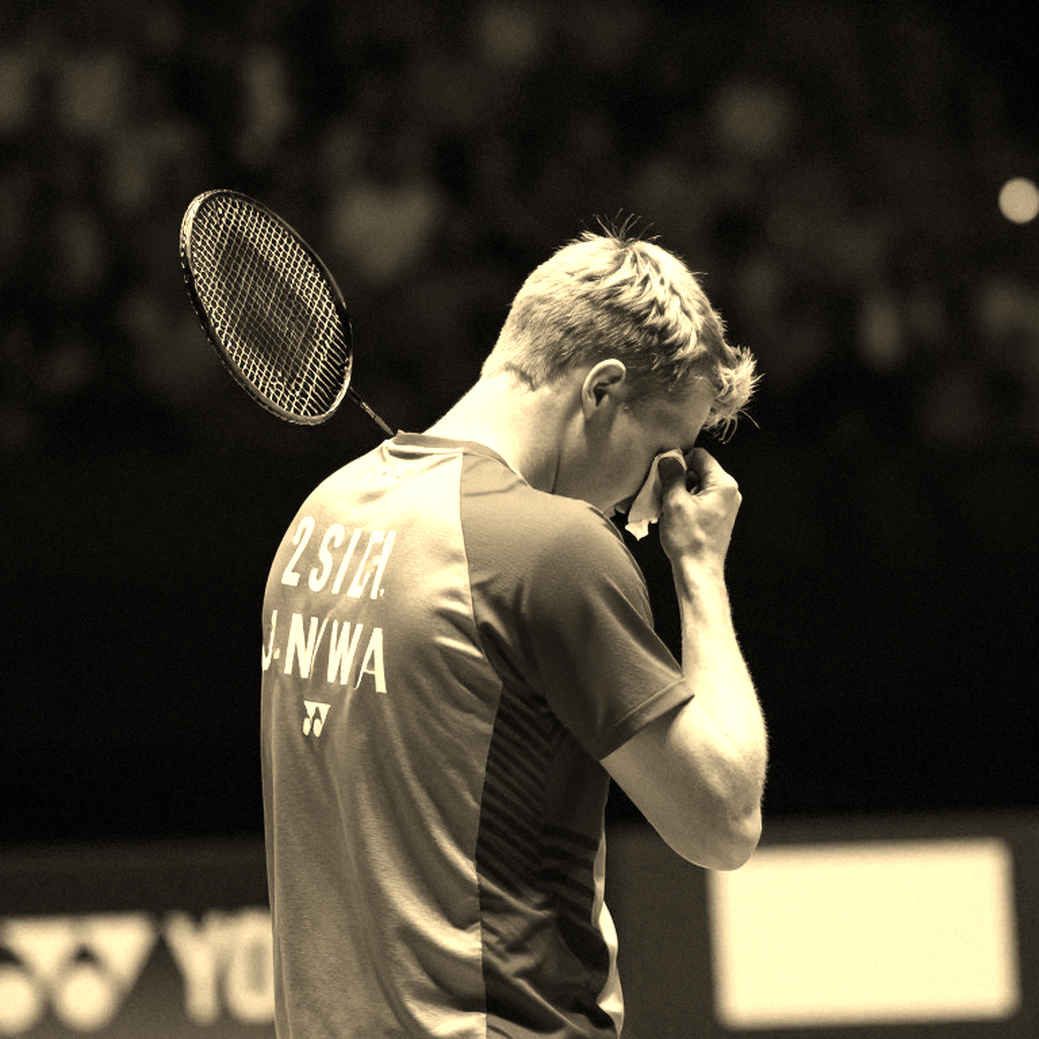
This leads to a deeper problem, and it does not live in the strength and conditioning room. It lives in the calendar. In a typical season, a Vietnamese player has only a handful of international events genuinely demanding enough to force them into tense third games. The rest are domestic tournaments, where the opponents are familiar, where the pace is lower, where a third game is no longer a psychological test. You cannot learn to survive a third game by reading about it. You have to die in third games a few dozen times first.
Where I could be wrong
I once wrote a tenth-grade blog to prove I was right. Now I write to prove I can be wrong. And here, I could be wrong in at least two directions.
First, my sample is small. Twelve matches are enough for me to believe a hypothesis, not enough for me to declare it a rule. Widen it to thirty matches and the numbers could flip, and the whole argument would collapse with them.
Second, and more importantly: the real problem may not be third-game thinking at all, but infrastructure. A national setup without a deep enough opponent-analysis specialist, without someone breaking down video to point out that a specific opponent likes to lift deep to the left corner between points 15 and 18, sends its player out with a blank map. In that case, every criticism about third-game mentality is aimed at the wrong person.
People call me a contrarian, but I am only trying to hear which applause actually carries. And the applause for a player winning a third game at a domestic event does not carry as far as the applause for a player losing a third game abroad.
What I will be watching
At the next international tournament with a Vietnamese player in the draw, I will not look at the result. I will look at a single number: the point differential for the Vietnamese player from point 15 onward in the third game. If that differential improves across two consecutive tournaments, then our fitness argument was wrong from the start. If it stays negative, the problem lies elsewhere, deeper, and far more expensive than a gym session.
I do not write to reconcile. I write to dig up the corners people are in a hurry to cover with soil. As for you, the next time you watch a Vietnamese player walk into a third game, try counting rallies instead of points. You will see the match being decided somewhere the scoreboard never displays.